What if Leadership development became part of the way a school operates rather than another thing students are taught? Can you imagine how different it would be to build Leadership into ordinary school practices rather than adding a lesson called “Leadership”? Theory certainly builds practice, but Leadership theory becomes meaningful when learners have the opportunity to experience it in real situations. The prerequisite for such an approach to Leadership is building a school culture that is open to sharing responsibilities with students and treating them as young people who can learn how to lead through experimenting, making mistakes, rescheduling, changing their plans and eventually accomplishing tasks that may traditionally have been perceived as requiring an adult presence. During this process, the school Leadership and Educators have a vital role to play because they are also part of the real-life experience taking place within the school while holding the role of the Mentor-Leader.
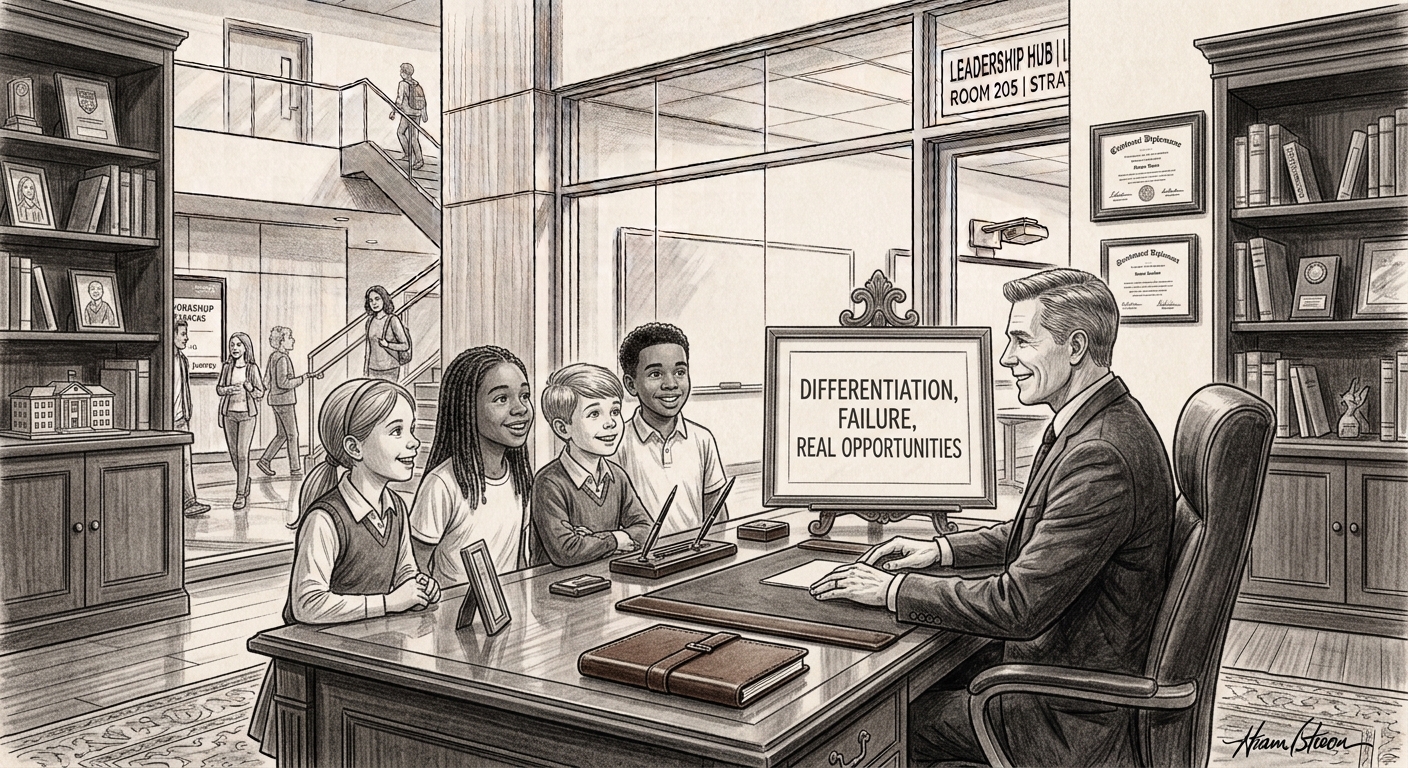
The Educator is always close to the students and, in some cases, also chooses innovation as a strong motivation for them. An Educator knows that enthusiasm can genuinely motivate students, so they are not afraid to make proposals that promote differentiation and introduce new experiences. In fact, new experiences can be particularly attractive to young learners who are not afraid of trying and failing. Failure is also something that the Educator needs to accept as part of the process. In my book The Leadership Manifesto, there is a clear explanation of how failure can become a state of mind that does not make the Leader feel exposed in front of students or colleagues, but instead becomes an opportunity for students to see Leadership developing through a failure that may initially seem inevitable but is, most importantly, necessary for learning.
With the TRU-GUT Method, students practice decision-making, responsibility, communication, negotiation and delegation without being told, “Today we are going to learn these five Leadership skills.” Leadership happens through the way the work is organized. Furthermore, the TRU-GUT Method can be applied in a way that gives students responsibility for solving real problems within the school. The role of the school Leadership and the Educators is to present the problem together with certain boundaries. The young learners then investigate it, speak to other students, propose solutions, negotiate between different ideas and present their proposal to the people who can actually make a decision. Some ideas will not work. Some will need to change. Some students will discover that having a good idea is not the same as being able to implement it. However, that is what makes the TRU-GUT philosophy special. Leadership becomes connected to consequences. Students experience what happens after they make a decision and learn to adjust the way they lead according to what happens next.
One of the greatest characteristics of a TRU-GUT-based program is that it gives learners the opportunity not only to lead themselves but also to lead others. This is not simply inspiring; it reveals to each student what they are capable of doing while giving them a significant purpose: sharing their experiences and knowledge with others. Such programs can introduce young learners to a more collective culture in which Leadership is understood as cooperation rather than simply standing out. Leadership itself cannot be redefined if we do not cultivate the idea that Leading is about cooperating and not just distinguishing yourself from others. Leadership is personal, but it becomes stronger when it moves beyond the individual. Loneliness in Leadership begins to disappear when people are not afraid to expose themselves to new experiences and to work with others.
TRU-GUT has a genuinely distinctive proposition. It proposes redesigning selected educational experiences so that young learners have real opportunities to lead.
Leadership becomes connected to consequences. Students experience what happens after they make a decision and learn to adjust the way they lead according to what happens next.The Leadership Manifesto