

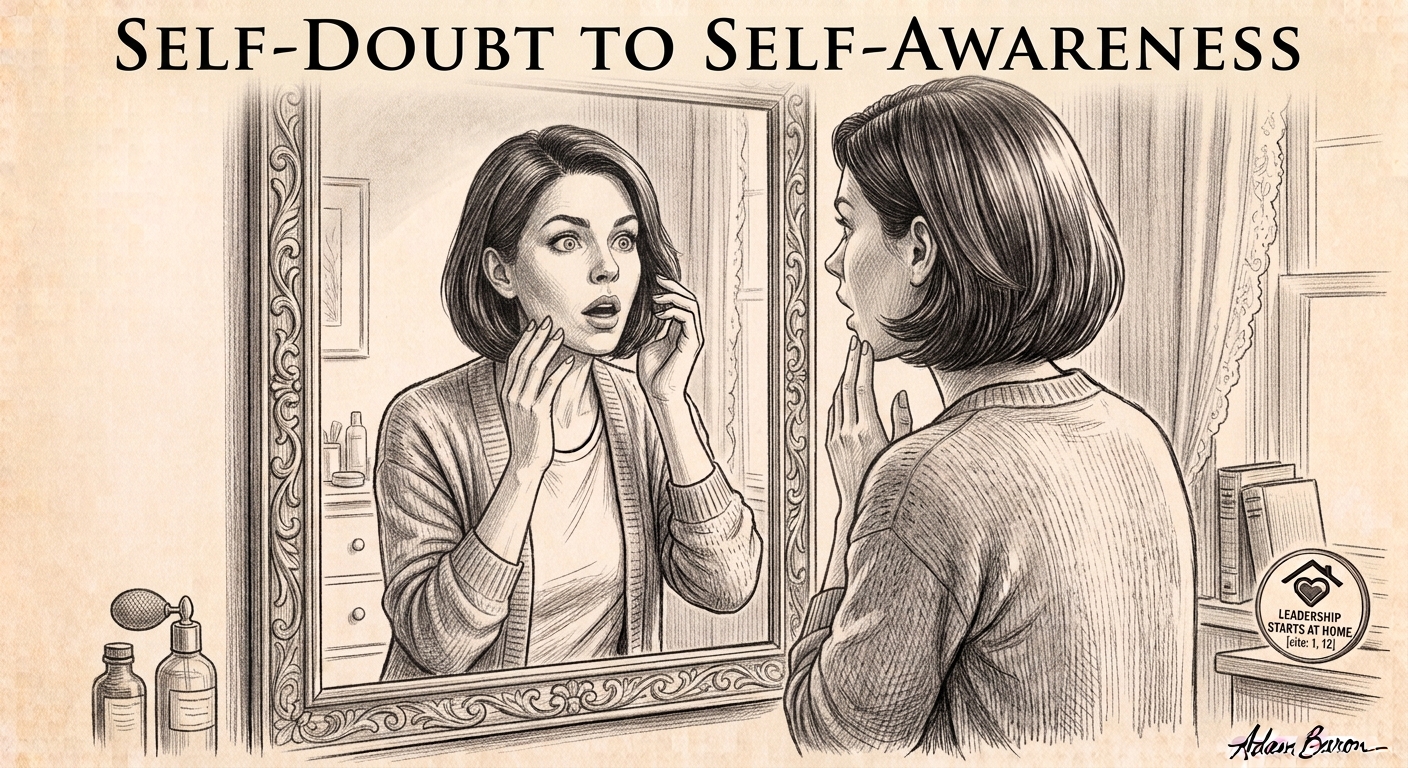
Once you start recognizing the Leadership you practice in your everyday life, another question appears: what can your everyday experiences teach you about yourself? This is where Leadership becomes more personal. It is not enough to realize that you make decisions, solve problems, set boundaries and manage difficult situations. You also need to understand how you do these things and what your choices reveal about the person you have become. Motherhood can make this very clear because it constantly puts us in situations that require us to respond, adapt and make decisions, often before we have had enough time to think about what we really want.
Many mothers spend a great deal of time judging their decisions. We ask ourselves whether we reacted correctly, whether we were too strict, too flexible, too involved, not involved enough, too ambitious or not ambitious enough. We compare ourselves with other mothers and often see their strengths more clearly than our own. We can also become so focused on what our children need that we stop asking what we need. Over time, this can create a very confusing situation. We may be making decisions every day, but we may not feel that we are leading our own lives. We are simply responding to whatever needs our attention next.
Looking at ourselves as Leaders can change this. A Leader needs self-awareness because decisions are influenced by values, fears, priorities, expectations and previous experiences. The same is true in motherhood. If you become angry every time your child questions a decision, there may be something behind that reaction that is worth understanding. If you find it difficult to say no to other people, you may need to examine your boundaries. If you constantly put your own plans aside, you may need to ask whether this is a conscious choice based on your priorities or a habit that you have never questioned. These observations are not about judging yourself. They are about understanding yourself well enough to make better decisions.
This is one of the most useful things that Leadership can offer women. Self-awareness gives us information about ourselves that we can actually use. If I understand that I tend to take control when I am under pressure, I can stop and decide whether taking control is really necessary. If I know that I avoid difficult conversations because I do not want to disappoint people, I can begin to work on communicating more directly. If I recognize that I am trying to do everything myself because I do not trust other people to do things in the way I would, I can ask whether I really need to control everything. These realizations can make everyday life easier because they give us another choice.
Motherhood offers many opportunities for this kind of observation. A child does not always respond in the way we expect. A plan can change within minutes. Something that worked yesterday may not work today. A mother may begin the day with one set of priorities and end up dealing with completely different needs. These situations can be exhausting, but they can also reveal how we respond to uncertainty and change. Do we become frustrated when we lose control? Do we adapt quickly? Do we ask for help? Do we continue with a plan that is clearly not working because we do not want to change it? Our everyday reactions can tell us a great deal about our Leadership style.
The same applies to the way we communicate. How do we speak when we are tired? How do we react when someone disagrees with us? Do we listen or do we immediately try to solve the problem? Do we explain our boundaries clearly or do we expect other people to understand them without being told? Do we give our children opportunities to make decisions or do we make most decisions for them because it is faster? These are not only parenting questions. They are questions about the way we lead people and the way we lead ourselves.
This is also where motherhood can challenge some of our unquestioned beliefs. We may have grown up believing that a good mother should always be available, that asking for help means that we cannot cope, that our children’s needs should always come before our own, or that changing our plans means that we have failed. But are these beliefs still useful to the woman we are today? Leadership requires us to examine the beliefs that influence our decisions rather than simply continuing to follow them. Sometimes becoming more aware of ourselves means realizing that a belief we have followed for years is no longer helping us.
This does not mean that every difficult experience in motherhood has a positive lesson. Some experiences are simply difficult. Some decisions will be wrong. Some situations will disappoint us. Some days will leave us exhausted. The point is not to turn every problem into a lesson or to pretend that everything happens for a reason. The point is to become more capable of looking at our experiences and deciding what we want to take from them. This is a much more realistic form of empowerment because it does not require us to believe that we are always strong or that we always know what to do.
Self-awareness can also help us separate responsibility from blame. A Leader takes responsibility for her choices, but she does not need to blame herself for everything that goes wrong. These are not the same thing. If something did not work, I can ask what part of the situation I can influence, what I could have done differently and what I want to change next time. I do not need to conclude that I am a bad mother, a bad partner or an unsuccessful woman. This distinction can be very important because constant self-blame does not help us make better decisions. Understanding our behavior does.
This is where recognizing Leadership in everyday life can become genuinely useful. It can help a woman understand why she feels overwhelmed, where she needs stronger boundaries, which responsibilities she needs to share, which decisions she has been avoiding and which priorities she may need to reconsider. It can also help her recognize strengths that she has stopped noticing because they have become part of her everyday life. The ability to organize a complicated family situation, negotiate between different needs, remain calm during a crisis, change a plan quickly or keep moving when something does not work are all experiences worth examining.
The purpose of the TRU-GUT Method is not to tell women that they should become perfect Leaders. It is to help them observe themselves more honestly and use what they discover. Leadership begins with awareness, but awareness should eventually lead to action. If you realize that you need a boundary, set one. If you realize that you are carrying responsibilities that should be shared, discuss them. If you realize that you have been postponing something important to you, reconsider your priorities. If you realize that a particular way of reacting is making a situation worse, try a different response.
This is why I believe that recognizing the Leader inside you can make you feel better about yourself without simply giving you another reason to feel proud. It can give you practical information about how you live, how you make decisions and what you can change. You do not have to become someone else to lead your life differently. You first need to understand the woman who is already making those decisions every day.
Motherhood does not give every woman the same experiences, and it does not automatically make every woman a better Leader. But it can give us countless opportunities to observe ourselves. If we choose to look at those experiences differently, they can help us understand our strengths, our limits, our priorities and the patterns that shape our decisions. And once we understand ourselves better, we have something very important that we did not have before: the ability to choose our next response more consciously.
The purpose of the TRU-GUT Method is not to tell women that they should become perfect Leaders. It is to help them observe themselves more honestly and use what they discover. Leadership begins with awareness, but awareness should eventually lead to action.The Leadership Manifesto