

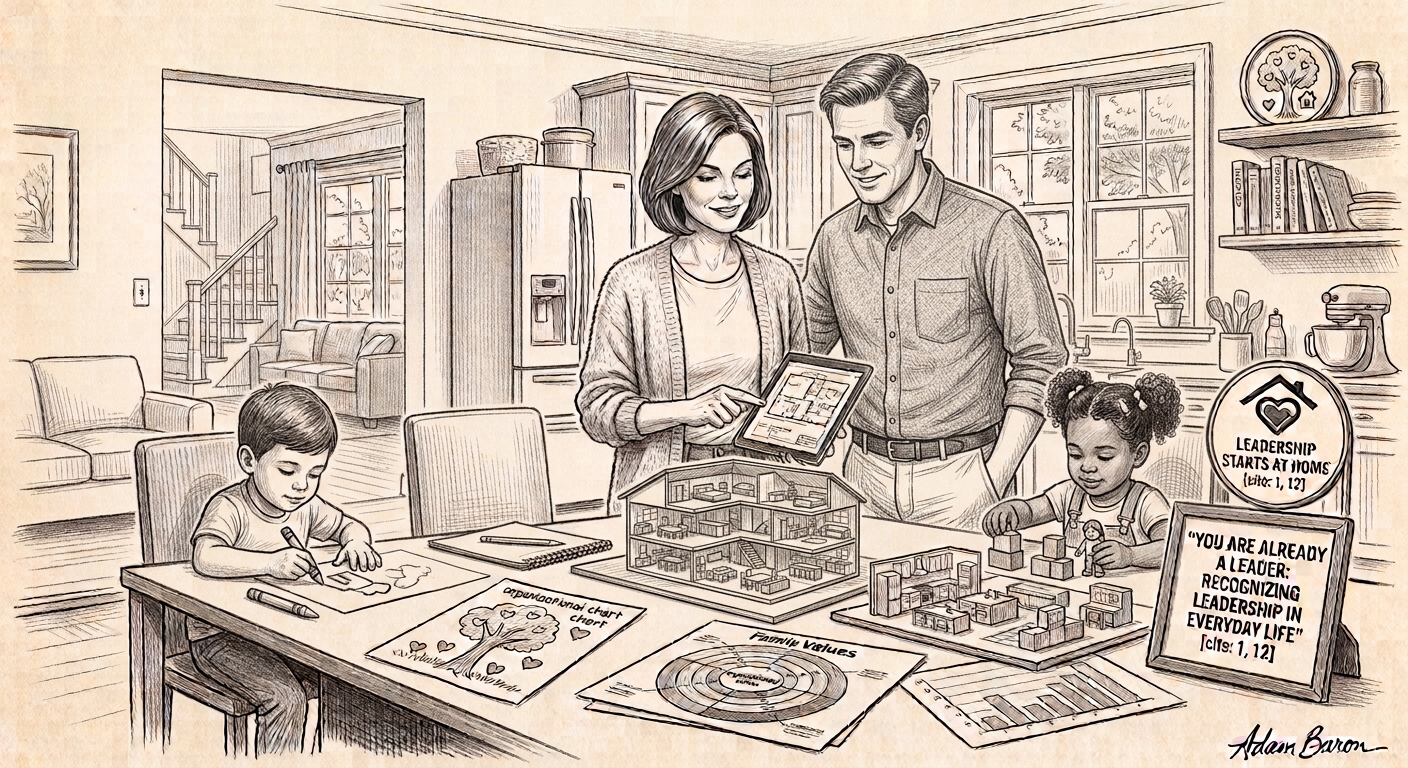
What if you are already practicing Leadership every day without calling it Leadership? Many women associate Leadership with a position, a profession, a title or the ability to lead other people. They may think about managers, business owners, politicians or people who are responsible for large teams. They may not think about themselves at all. Yet Leadership is not only about being in charge of other people. It is also about making decisions, taking responsibility, setting priorities, dealing with difficult situations, communicating with others and finding a way forward when there is no obvious solution. When we look at Leadership in this way, we can start recognizing it in many parts of our everyday lives.
Motherhood makes this especially clear. A mother makes decisions constantly. She decides what is important, how to respond to problems, when to insist, when to step back, when to protect, when to allow independence and when to change her approach. She manages unexpected situations, negotiates with different personalities, deals with conflict, sets boundaries and often has to make decisions without knowing exactly what the result will be. She may do all of this without ever thinking, “I am using Leadership skills now.” She may simply think that she is trying to get through another difficult day
.
This is one of the reasons why I believe that Leadership starts at home. It does not mean that motherhood and professional Leadership are exactly the same. They are not. However, they require many similar abilities. Both involve responsibility, communication, decision-making, adaptability, emotional awareness, setting priorities and understanding the people around you. The difference is that mothers often practice these abilities without recognizing their value. They may see what they do as part of their daily obligations rather than as evidence of what they are capable of.
Recognizing this can change the way a woman sees herself. When you understand that you have already been making difficult decisions, solving problems, managing relationships and adapting to situations that you did not choose, you may start looking at your own abilities differently. You may also stop comparing yourself so much with other women because you begin to understand that your own experiences have already taught you something about yourself. Leadership is not about becoming someone else. It is about understanding what you have already learned from your own life and deciding how you want to use it.
This is particularly important for mothers because motherhood can easily make women question themselves. We are often quick to focus on what we did wrong, what we did not manage to do, what another mother seems to do better or what we think we should have done differently. We can spend so much time evaluating ourselves that we forget to recognize what we have actually achieved. Looking at motherhood through the perspective of Leadership does not mean ignoring our mistakes. It means learning to examine them without reducing ourselves to them.
A mother who recognizes herself as a Leader can ask different questions. Instead of asking only, “Was I a good mother today?” she can also ask, “How did I respond to this situation?”, “Why did I make that decision?”, “Did I communicate what I really meant?”, “Did I give my child enough space to make a decision?”, “Did I set a boundary because it was necessary or because I was afraid?”, and “What can I learn from what happened?” These questions do not make motherhood easier, but they can make our responses more conscious.
The same perspective can also help women outside motherhood. The Leadership they practice in their families can influence the way they approach their professional lives, relationships and personal decisions. A woman who has learned to manage difficult situations at home may discover that she has more ability to deal with difficult situations at work than she previously believed. A woman who has learned to set boundaries may realize that she needs stronger boundaries in another part of her life. A woman who has learned to listen to her children without immediately giving them the answer may also discover a different way of communicating with colleagues or other people around her.
This is not about saying that motherhood automatically makes every woman a Leader. It does not. Experience alone does not guarantee self-awareness or good Leadership. What matters is whether we are willing to observe our own behavior, question our decisions, learn from our experiences and make changes when something is not working. This is where Leadership becomes a personal journey rather than a title.
The TRU-GUT Method starts from this idea. Before asking women to become better Leaders, we can first help them recognize the Leadership that is already present in their everyday lives. We can look at the decisions they make, the responsibilities they carry, the boundaries they set, the problems they solve and the way they respond to the people around them. We can then begin to question whether these choices are really helping them build the life they want. Because recognizing yourself as a Leader is not simply about feeling more confident. It can give you another way to understand your life.
You may realize that you are capable of making decisions that you have been avoiding. You may understand why certain situations repeatedly exhaust you. You may see that you need to set a boundary instead of continuing to tolerate something that does not work for you. You may realize that you are trying to control something that you actually need to let go of. You may discover that a decision you considered a failure has actually taught you something important about yourself. This is where Leadership becomes practical.
It is not about adding another responsibility to a woman’s already full life. It is about giving her a different way to look at the life she is already living. When a woman starts recognizing herself as a Leader, she can begin to make decisions with greater awareness of her values, her priorities, her abilities and her limitations. And perhaps this is where we need to start. Before asking women to become stronger, more confident or more successful, we should first help them recognize what they are already capable of doing. Because you may not have called yourself a Leader. But you may have been practicing Leadership for years.
Motherhood and Professional Leadership are not exactly the same. However, they require many similar abilities. Both involve responsibility, communication, decision-making, adaptability, emotional awareness, setting priorities and understanding the people around you. The difference is that mothers often practice these abilities without recognizing their value. They may see what they do as part of their daily obligations rather than as evidence of what they are capable of.The Leadership Manifesto